Poole Waste Not Want Not
Project Overview: Poole WNWN
Poole Waste Not Want Not is a member-based social supermarket supporting vulnerable individuals and families across Bournemouth, Christchurch, and Poole. Unlike traditional food banks, it operates on dignity and choice - members shop regularly, selecting their own food at 50-75% below standard prices.
This project addresses the charity's most critical challenge: reaching isolated individuals who need support but are held back by stigma and shame. The campaign strategy shifts focus from crisis intervention to social connection, empowering trusted networks to offer dignified, low-pressure invitations.
The Challenge: Combating Food Poverty Stigma
The primary barrier to accessing support isn't lack of need - it's fear of social stigma. For many, the deep embarrassment associated with seeking help outweighs the urgency of their situation. This silence keeps people isolated, preventing them from accessing support until they reach a breaking point.
Research reveals that 16% of food bank users have no internet access, making direct-to-user social campaigns ineffective. Furthermore, traditional charity messaging often relies on "poverty porn" - sad, desaturated imagery that heightens shame rather than reducing it.
The challenge was clear: create a campaign that bypasses defensive walls of pride, reaches digitally excluded individuals, and reframes support as a natural extension of community care rather than a rescue mission.
Strategic Approach: The "Someone You Know" Insight
The breakthrough insight: friends and family notice the small changes first. The cancelled plans, the empty fridge, the quiet withdrawal from social life. They are the trusted messengers who can offer support without causing offense.
Rather than asking struggling individuals to admit failure, the campaign speaks to the people standing next to them. This pivot is critical - it changes the dynamic from a charity asking a stranger to self-identify as "poor" to a trusted friend sharing a useful resource.
The campaign title, "Someone You Know Might Need This," validates the intuition of observers and provides gentle language to start conversations. It removes the shame of the "ask" by placing the invitation in the hands of a loved one.
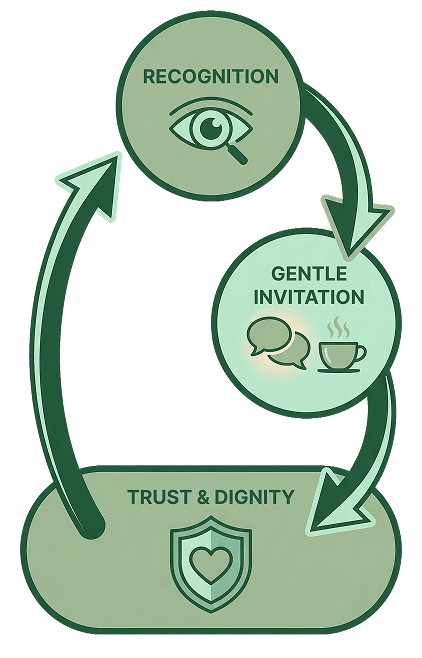
To navigate the complex emotions surrounding financial hardship, I developed a bespoke framework that prioritizes self-worth over clinical process. This model serves as a humanity-led audit tool, ensuring dignity remains the primary filter for every strategic decision.
Dignity: Shifts focus from fear of causing shame to community pride. The strategy proves that recommending support is a safe act of care that protects a friend's self-worth.
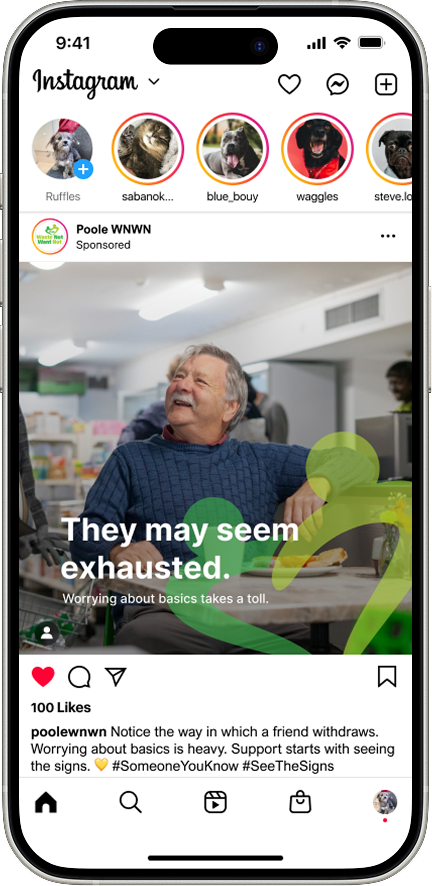
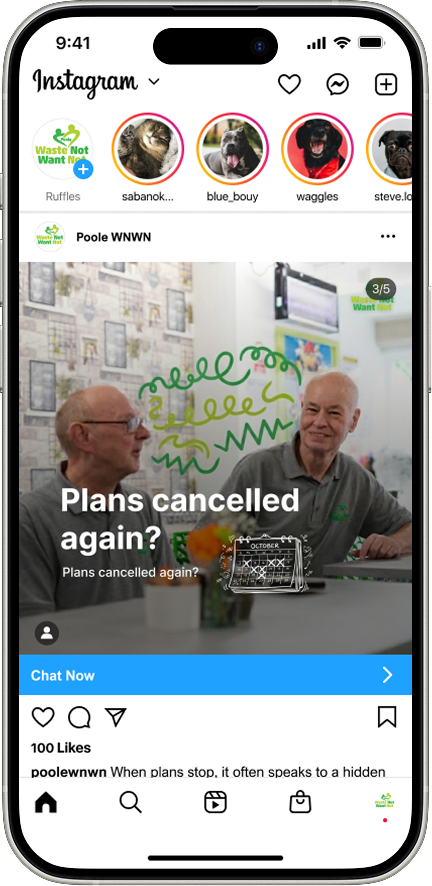
Recognition: Swaps clinical diagnosis for spotting subtle behavioral shifts. It equips friends to notice quiet withdrawal or cancelled plans, allowing support to arrive before a crisis hits.
Soft Invitation: Replaces formal intervention with shared social experience. By framing the first visit as a trip for coffee or shopping together, it ensures the first step feels equal and low-pressure.
A framework prioritizing dignity, recognition, and soft invitation
Campaign Structure
The campaign unfolds across three strategic pillars, each building on behavioral change research and anti-stigma theory:
Awareness: "See the Signs"
Encourages family and friends to recognize subtle behavioral shifts before they reach a
breaking point. By prompting people to notice small changes, the campaign validates that
observation is the first vital step in supporting those we care about.
Connection: "Start the Conversation"
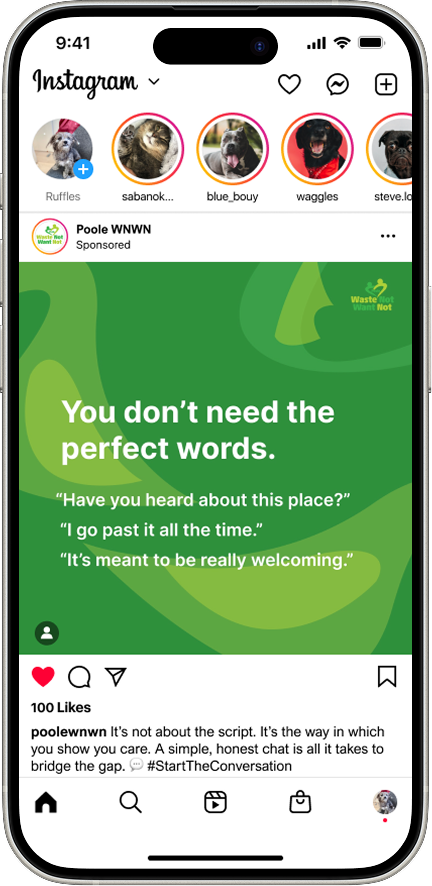
Provides the language to discuss hardship without stigma or offense. This pillar normalizes
the suggestion of help, transforming a potentially awkward discussion into a natural,
empathetic act of kindness.
Action: "Take the First Step"
Frames the initial visit as a shared social experience rather than formal intervention.
By empowering friends to offer a gentle invitation to "go together," it converts awareness
into the real action of walking through the door.
Design Execution
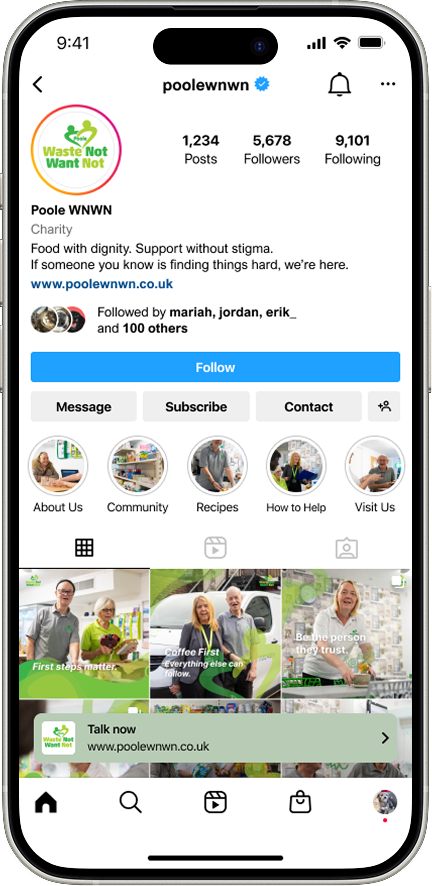
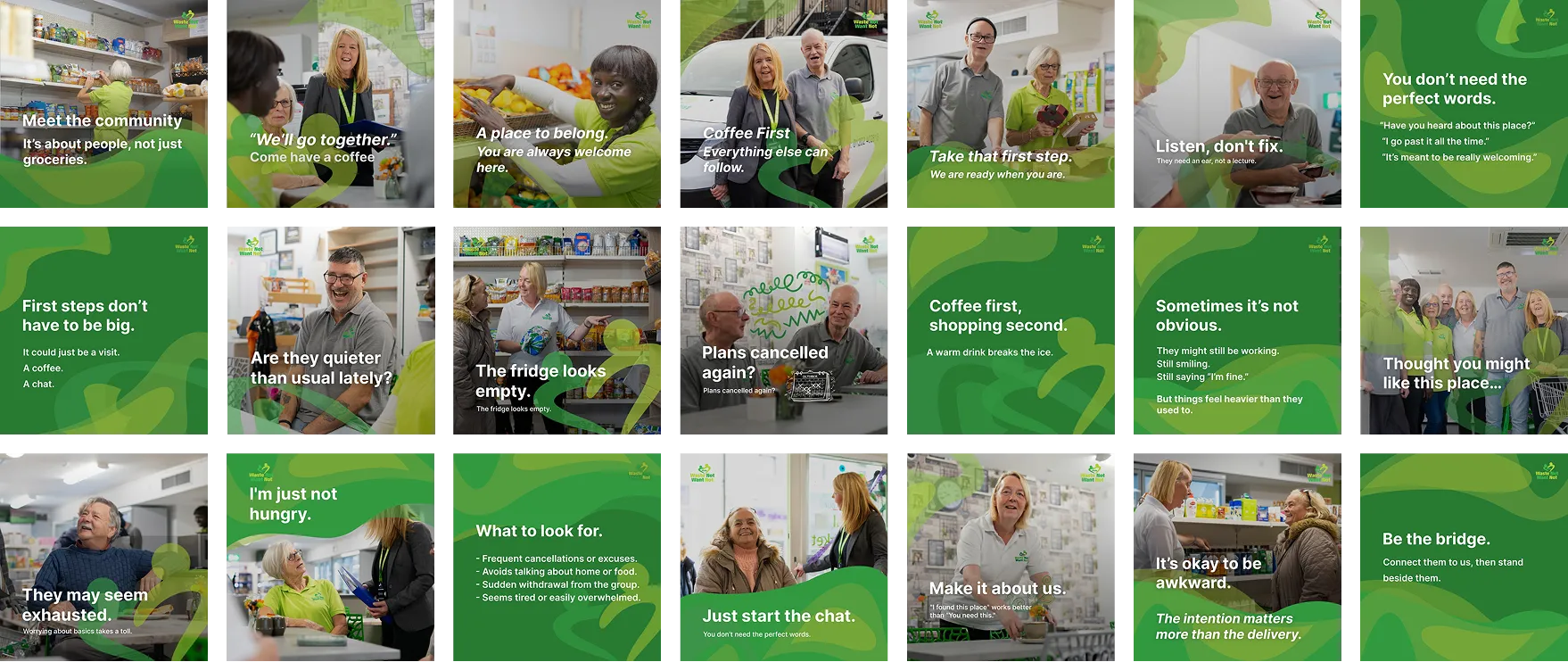
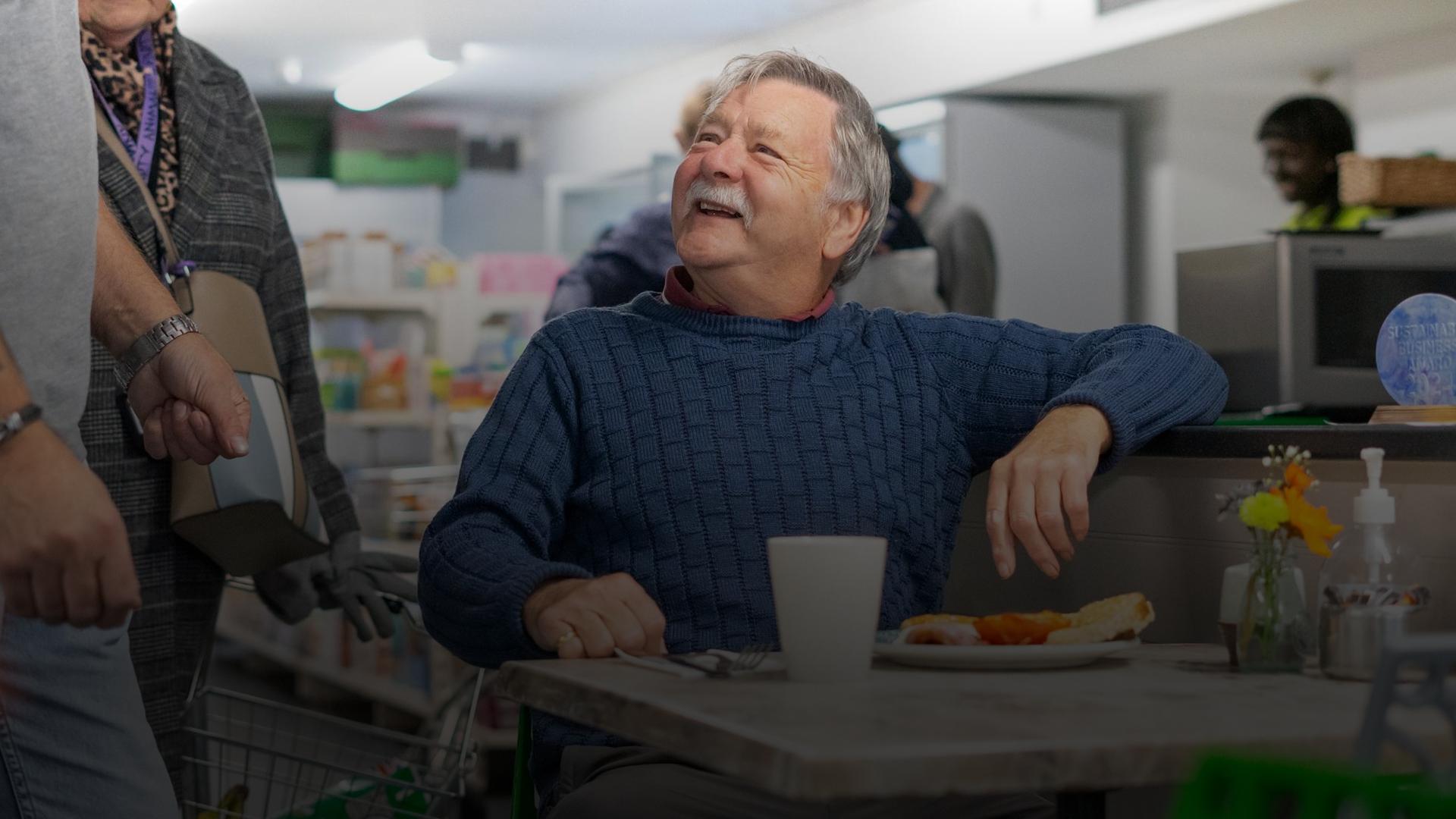
The visual system prioritizes dignity over pity. Every design choice reinforces the charity's welcoming atmosphere - no sad imagery, no desaturated tones, no "poverty porn." Instead, the campaign uses warm greens traced from the charity's logo, everyday photography showing people browsing shelves and chatting over coffee, and calm, judgment-free language.
The social media content alternates between photo posts and solid-color text posts, ensuring key messages remain scannable and the feed feels approachable rather than overwhelming. Each post passes three tests: Does it build trust? Does it aid recognition? Is it a soft invitation?
Impact: Measuring Social Change
This project redefines what intervention looks like. It moves the experience away from a transaction of need toward a moment of reconnection. By relying on existing relationships, the campaign doesn't just deliver food - it uses the trust that already exists between people to bridge the gap that charity alone cannot cross.
The "Someone You Know Might Need This" strategy succeeds because it respects the silence of the user. It acknowledges that the person struggling is likely hiding it from everyone. Instead of forcing them into the open with a spotlight, we quietly equip their friends with a torch.
Ultimately, this campaign establishes a new standard for dignity-first communication. Every element reinforces member self-worth, replacing the barrier of stigma with the trust of a personal invitation. By making "going together" the default path to support, we ensure that walking through the door feels as normal and dignified as visiting any other shop on the high street.
Strategic Outcomes
De-Stigmatized Access
Reframed support as a shared social activity ("let's go shopping"), successfully lowering the psychological barrier to entry for first-time users.
Community Activation
Empowered existing networks of friends and family to act as "trusted messengers," bypassing the distrust often felt towards cold institutional outreach.
Dignified Experience
Established a new standard for member-focused design, ensuring every touchpoint—from social post to shop floor—reinforces self-worth over pity.